
Infotainment System
Case Study
Overview
Client: Mercedes-Benz AMG
Role: Recruiter, coordinator, moderator/interviewer
Dates: September 2024
Setting: In-person research
Research Question
How does the information architecture and interaction design of the AMG infotainment system impact driver experience, perceived safety, and confidence during use?
Why This Study Matters
The AMG infotainment system is a critical interface used in high-attention, time-sensitive driving contexts. Poor usability does not merely reduce satisfaction, it increases cognitive load and may have potential safety risks. This study focused on identifying early usability risks and opportunities to improve clarity, efficiency, and trust.
Success Criteria:
Success was defined as reducing interaction steps and perceived cognitive load during high-frequency tasks, with observed improvements in glance behavior and reduced confusion.
What was NOT studied:
This study did not evaluate long-term learning effects or quantify glance-time metrics while driving, both of which are recommended for future validation.
[Visual: Study overview diagram showing methods + participant segments]
Research Approach
Methodology & Structure
This was a formative, moderated qualitative research study combining:
1-hour Focus groups (to surface expectations, mental models, and attitudes)
30-minute Moderated, task-based usability testing on the vehicle’s central display console
30-minute In-depth interviews (IDI)
Methodology Rationale
This study focused on formative usability evaluations within a constrained, safety-sensitive testing environment. Given the exploratory nature of the research and the focus on identifying friction points in high-frequency driving tasks, the study emphasized qualitative observation, task flow analysis, and participant feedback over instrumented performance metrics.
Why Formative?
The goal was to identify usability risks early, before refinement or large-scale rollout.
Participants
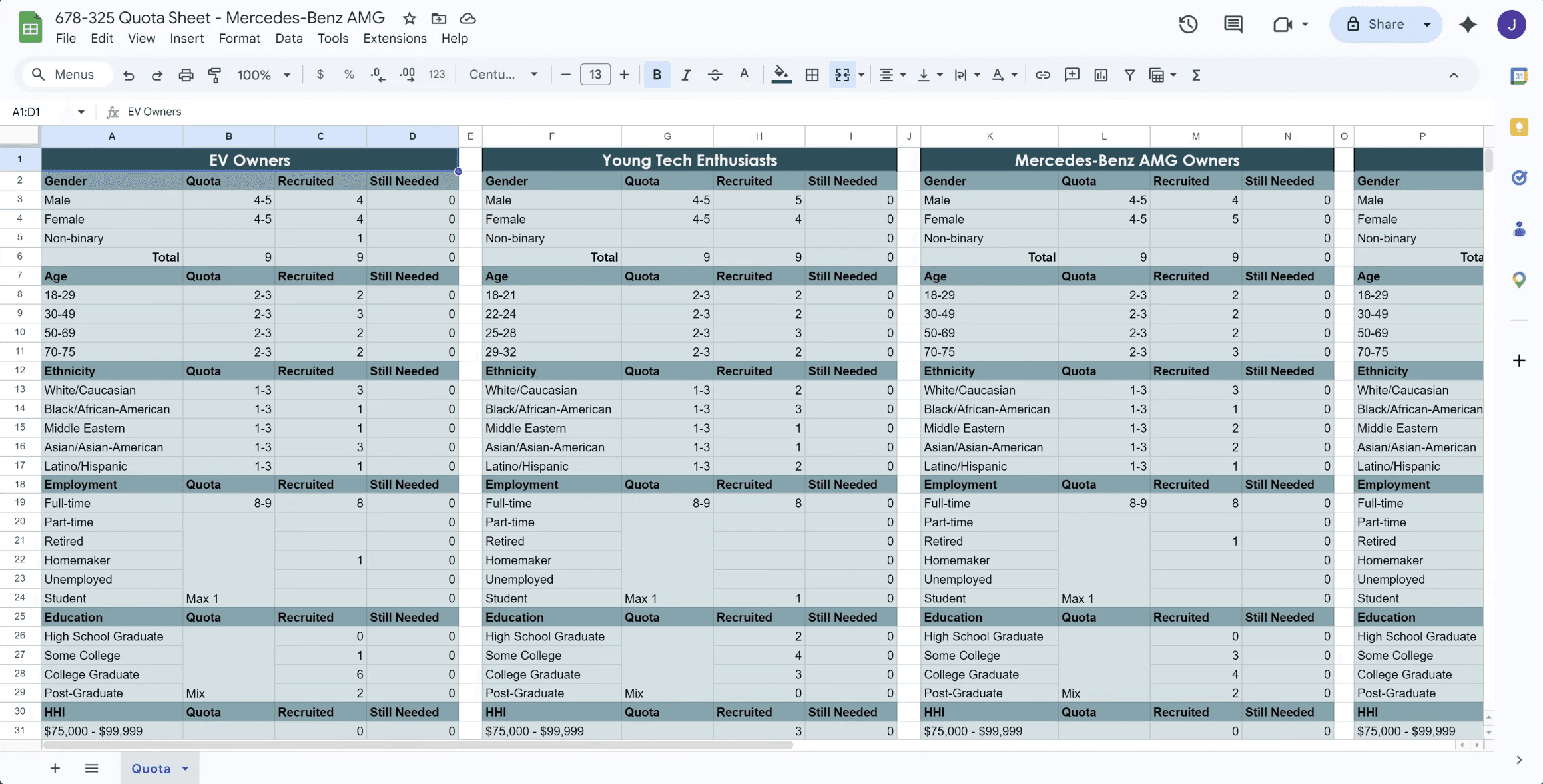
Total Participants: Recruited 45 to seat 40
Focus Groups: 5 groups of 8 participants
Segments Represented:
Group 1:
Electric vehicle owners
Group 2:
Young technology enthusiasts
Group 3:
Mercedes-Benz AMG owners
Group 4:
Competitor owners (BMW, Audi, Lucid, Porsche, Tesla)
Group 5:
Mixed profiles across the above
Demographics:
Gender: Aimed for a 50/50 mix
Age Range: 18–75
Ethnicity: Recruited a mix
Minimum n = 8 Black/African American respondents
Minimum n = 8 Latino/Hispanic respondents
Minimum n = 8 Asian/Asian-American respondents
Minimum n = 8 Middle Eastern respondents
Minimum n = 8 White respondents
Minimum n = 5 Additional respondents from any ethnic backgrounds
Education: High school graduates and higher
HHI: Single Income: $75K+; Dual Income: $150K+, recruited a range
Employment:
None that currently or previously worked in related industries (market research, automotive industry)
Homemaker, retired, part-time employed, and/or student (Max n = 1 per group)
Eligibility Criteria:
All must be primary or shared financial decision-makers
Familiarity with modern in-vehicle infotainment systems
Qualifying vehicle year must be 2020 or newer
Additional Criteria:
Past Participation: None to have participated in market research within the past 3 months; none to have participated in automotive research in the past 6 months
Willing to sign a respondent waiver agreement and NDA
Willing to show proof of active drivers license, vehicle registration, and insurance for qualifying vehicle
Usability Tasks
Participants completed realistic driving-related tasks designed to evaluate interaction cost and discoverability:
Identify AMG specific apps
Change driving mode to Sport+ then to Eco
Locate tire temperature information
Change EV charging settings from efficient to fast charging
[Visual: Task list + success rate summary]
Analysis
Data was synthesized using:
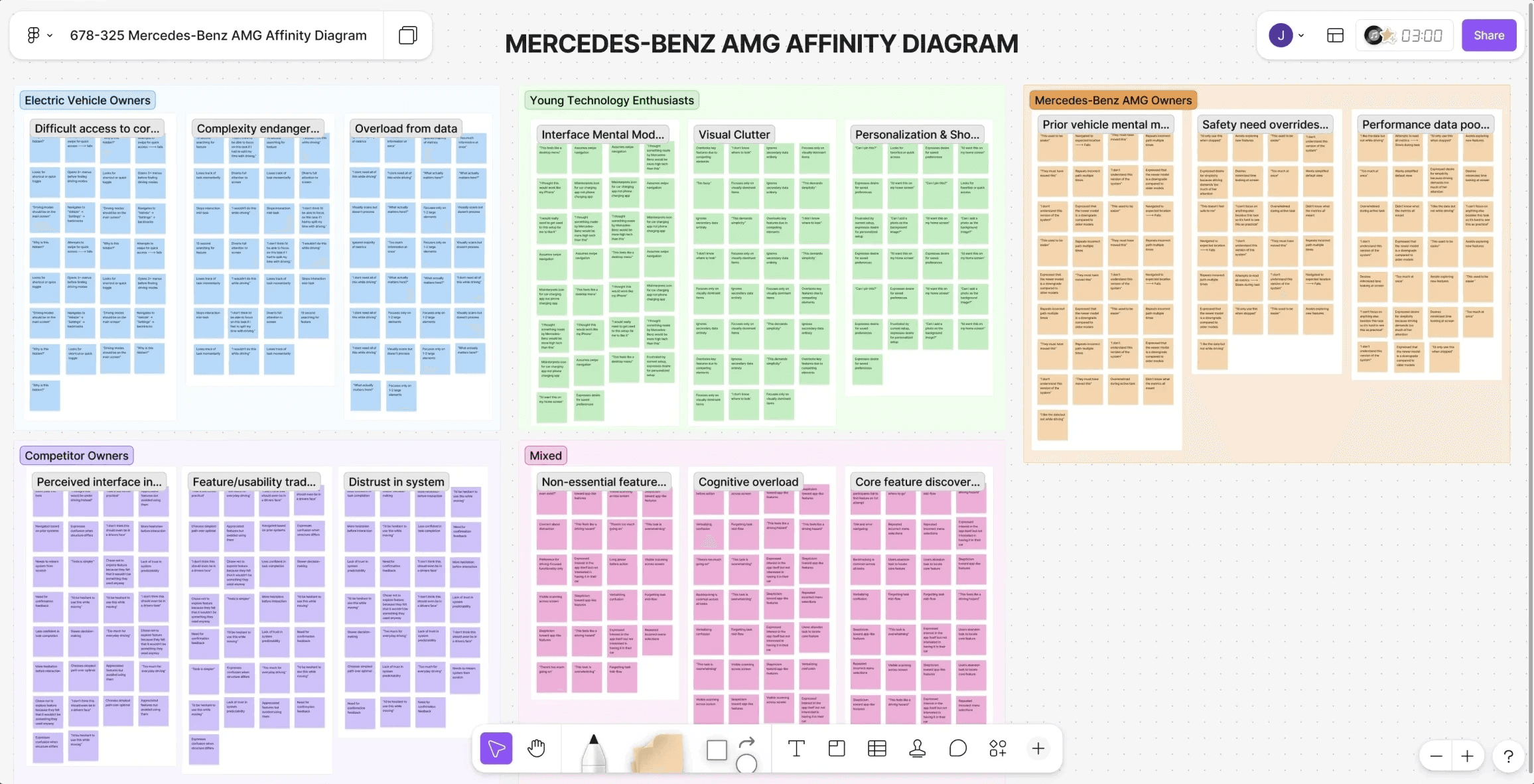
Tagging and taxonomy development
Qualitative coding
Affinity Diagramming
Patterns were analyzed across segments to identify systemic usability issues rather than individual preferences.
A mixed deductive and inductive approach was used to validate predefined usability hypotheses while remaining open to emergent behavioral patterns and safety risks.
Key Findings & Insights
1. Poor Information Architecture Increased Interaction Cost for Core Driving Functions
Finding
Participants struggled to locate essential driving functions due to a mismatch between their mental models and the system’s information architecture. Core features were often buried within unclear categories or labeled in ways that did not align with driver expectations.
UX Interpretation
When information architecture conflicts with user mental models, interaction cost increases, especially in time sensitive driving scenarios. Drivers are forced to allocate cognitive resources toward navigation rather than situational awareness. In a high-risk context, even minor friction erodes perceived system reliability and confidence.
Recommendation
Simplify navigation hierarchy and improve feature grouping based on validated driver mental models
Standardize iconography and labels using established automotive conventions
Prioritize core driving functions within primary navigation layers
2. Information Density Exceeded Cognitive Capacity
Finding
Performance screens displayed excessive data optimized for expert users. The volume of metrics created visual clutter, making it difficult for most drivers to identify relevant information quickly.
UX Interpretation
Driving is a cognitively demanding task. When information density exceeds processing capacity, users experience cognitive overload. Rather than enhancing control, excess data fragments attention and increases distraction risk. Clarity drives confidence in high attention environments.
Recommendation
Reduce information density and establish clear visual hierarchies
Emphasize primary metrics while progressively disclosing advanced data
Design contextual displays that surface only task-relevant information
3. Drivers Preferred Interfaces That Adapt to Their Habits and Leverage Familiar Interaction Patterns
Finding
Participants expressed strong preference for customization and familiar interaction patterns. Personalization was viewed not as aesthetic enhancement, but as a way to reduce friction and quickly access frequently used features.
UX Interpretation
Familiarity reduces cognitive effort. When interfaces reflect user habits and learned behaviors, interaction becomes automatic rather than effortful. Adaptive structures increase perceived control, shorten task time, and strengthen trust — particularly in environments where attention is limited.
Recommendation
Introduce user profiles that surface high-frequency actions
Provide one-touch access to commonly used driving functions
Implement adaptive layouts that respond to usage patterns while maintaining consistency
4. Strong Resistance to Non-Essential In-Vehicle Apps
Finding
Participants were skeptical of a broad app-store model within the vehicle. Many voiced concern that non-driving related applications could introduce distraction and dilute the system’s purpose.
UX Interpretation
In safety-critical environments, users evaluate features through a risk lens. Perceived “non-essential” functionality undermines trust and shifts the system from purpose-built tool to potential distraction. Relevance and restraint signal safety and design intentionality.
Recommendation
Prioritize purpose-built, vehicle-specific functionality
Establish strict guidelines for third-party integrations
Explore adaptive systems that prioritize features based on driving context and safety constraints
[Visual: Recommendation roadmap]
Ethical Considerations
Informed consent obtained
Voluntary participation
Data anonymized
Impact & Takeaways
This study identified critical usability and safety risks within the AMG infotainment system related to discoverability, cognitive load, and interaction cost. Addressing these issues presents an opportunity to:
Improve driver confidence and satisfaction
Reduce distraction and safety related risk
Strengthen trust in AMG’s performance-focused brand promise
What I’d Do Next
Validate revised navigation models through iterative usability testing
Conduct glance-time and workload assessments for high-risk interactions
Perform quantitative metric focused research while operating vehicle